
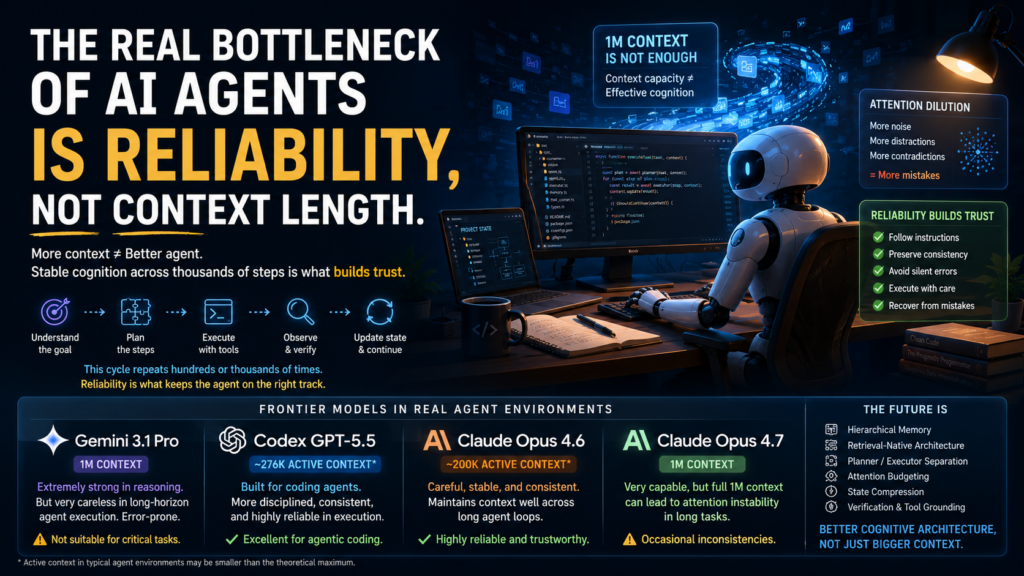
Over the past few months, I have been comparing several frontier models in real agent environments:
– Gemini 3.1 Pro High
– Codex GPT-5.5 XHigh
– Claude Opus 4.6 Thinking
– Claude Opus 4.7 Max
What I have observed is becoming increasingly clear to me:
A larger context window does not automatically make a better agent.
In fact, in some cases, a larger context window may make the model less reliable in long-horizon execution.
This sounds counterintuitive because the industry has spent the past two years treating context length as one of the most important indicators of model progress. We moved from 8K to 32K, then to 128K, 200K, 400K, 1M, and beyond. Every jump looked like a major milestone.
And in many ways, it is.
A 1M-token context window is genuinely useful. It allows a model to ingest long documents, code repositories, transcripts, papers, legal materials, and multi-file project histories in one pass. Gemini 3.1 Pro, for example, is officially described as supporting a 1M-token context window across text, audio, images, video, PDFs, and code repositories. Claude Opus 4.7 is also documented as providing a 1M-token context window. GPT-5.5 Pro in the API is documented with a 1,050,000-token context window, while GPT-5-Codex, the coding-agent-oriented version, is documented with a 400K context window.
So the direction is obvious: every major lab is pushing toward longer context.
But after using these models inside actual agent workflows, I think we need to separate two very different capabilities:
1. The ability to accept a large amount of context
2. The ability to maintain a stable cognitive state while acting over that context
These are not the same thing.
And for agents, the second one matters far more.
Static Intelligence vs. Dynamic Reliability
One of the most important distinctions I have come to appreciate is the difference between static intelligence and dynamic reliability.
Static intelligence is what we usually test in ordinary prompting:
– Can the model solve a hard math problem?
– Can it explain a complex idea?
– Can it reason through an architecture?
– Can it synthesize information from multiple sources?
– Can it produce a deep conceptual analysis?
Many frontier models are extremely strong here.
Gemini 3.1 Pro, for example, can be highly impressive when analyzing difficult mathematical or conceptual problems. It can produce elegant reasoning, strong abstractions, and sophisticated explanations. Claude Opus 4.7 can also be excellent in high-level reasoning and knowledge work. These models are not “dumb” at all. In many cases, they are extraordinarily capable.
But agent work is different.
Agent work is not a single act of reasoning.
Agent work is recursive execution.
An agent has to:
– Read files
– Understand project state
– Plan changes
– Modify code
– Call tools
– Interpret tool results
– Update its mental model
– Preserve prior constraints
– Avoid damaging existing behavior
– Track what has already been changed
– Continue across many steps without drifting
That is a different kind of intelligence.
It is not just about being able to reason deeply. It is about being able to remain stable while reasoning, acting, observing, and revising over many iterations.
This is where I see major differences between models.
The Surprising Strength of Smaller Active Context
In my own agent usage, Codex GPT-5.5 and Claude Opus 4.6 have often felt more reliable than some larger-context configurations.
This is especially interesting because in the environments I have used, Codex GPT-5.5 may expose a much smaller active context than the theoretical maximum available in some API settings. Claude Opus 4.6 may also run in a smaller effective context configuration depending on the environment.
And yet, in practice, these two often feel more careful.
They are not just smart. They are disciplined.
In coding-agent workflows, that matters enormously.
A reliable coding agent must avoid subtle errors such as:
– Changing one file but forgetting a dependent file
– Renaming a variable but missing a reference
– Updating an interface but not updating all implementations
– Modifying schema logic while leaving outdated documentation
– Fixing the happy path while breaking edge cases
– Producing a patch that looks plausible but fails integration
– Silently corrupting a part of the project that was not supposed to be touched
These are not dramatic reasoning failures.
They are small attentional failures.
But in software engineering, small attentional failures are catastrophic.
A model can understand the architecture perfectly and still be dangerous if it cannot preserve consistency across a long execution chain.
This is why I increasingly believe that “carefulness” is not a cosmetic trait in AI agents. It is a core capability.
Gemini 3.1 Pro: Very Smart, But Often Too Unreliable for Critical Agent Work
My experience with Gemini 3.1 Pro has been especially revealing.
In static reasoning tasks, it can be extremely impressive. Ask it to analyze a difficult mathematical question, a deep conceptual framework, or a complex theoretical issue, and it may produce a beautifully structured response.
But in agent environments, I have repeatedly seen a very different pattern.
The model can become surprisingly careless.
Not occasionally careless. Often careless.
In my experience, the issue is serious enough that I would not trust Gemini 3.1 Pro with critical agent tasks where execution correctness matters.
The most frustrating part is that the model may understand the task perfectly at a high level. It may even explain the right approach. But when it has to execute, it starts making avoidable mistakes:
– It misses explicit instructions.
– It skips required steps.
– It forgets constraints that were already stated.
– It modifies the wrong area.
– It fails to preserve consistency.
– It produces incomplete edits.
– It mishandles tool outputs.
– It appears to “understand” the task but fails to carry it out accurately.
This is not a lack of intelligence.
It is a lack of execution reliability.
And this distinction matters.
A model that cannot solve a problem is easy to detect. It gives a bad answer.
A model that understands the problem but executes unreliably is much more dangerous. It gives you confidence while quietly damaging the state of the project.
In agentic coding, this is one of the worst failure modes.
Claude Opus 4.7: Stronger, But Not Immune
Claude Opus 4.7 feels different from Gemini 3.1 Pro. It is generally stronger and more usable in many professional workflows.
But I have still noticed a related issue when using it in long-context agent environments.
With its full 1M-token context available, Opus 4.7 can sometimes become less precise in coding and long-document work than I would expect from a model of its intelligence level.
Again, the errors are often not signs of stupidity.
They are signs of attention instability:
– Small inconsistencies
– Minor omissions
– Partial updates
– Slightly wrong assumptions
– Missed constraints
– Drift across a long document
– Code changes that are directionally right but not fully synchronized
This is much less severe than what I have seen from Gemini 3.1 Pro, but it points to the same underlying problem:
Long context is not the same as stable working memory.
A model may be able to hold 1M tokens in the prompt, but that does not mean it can use all of them with equal precision, equal priority, and equal consistency over a long task.
There is a difference between context capacity and cognitive control.
The “1M Context” Illusion
The industry often talks about context windows as if they are storage containers.
A 1M-token model is described as if it can simply “read” and “remember” 1M tokens.
But that framing is misleading.
A context window is not a database.
It is not a perfect memory.
It is not a deterministic retrieval system.
It is an attention field.
And attention is limited.
Even if a model can technically accept 1M tokens, it still has to decide:
– What matters?
– What should be ignored?
– Which instruction has priority?
– Which file is relevant?
– Which previous step is still active?
– Which constraint must be preserved?
– Which local detail affects the current edit?
In a short prompt, these decisions are easy.
In a 1M-token agent context, they become extremely hard.
The problem is not that the model “cannot see” the information. The problem is that it may not assign the right importance to the right information at the right time.
This is why I think the phrase “effective context” is more important than “maximum context.”
Maximum context answers the question:
“How many tokens can the model ingest?”
Effective context answers the question:
“How much of that context can the model reliably use?”
For agents, effective context is what matters.
Why Coding Exposes the Problem So Clearly
Coding is one of the harshest tests of model reliability because software has very low tolerance for inconsistency.
A philosophical essay can survive a vague paragraph.
A business plan can survive a slightly imperfect transition.
A mathematical explanation may still be useful even if it skips some detail.
But code is unforgiving.
If a model forgets one import, the program may fail.
If it changes an API contract but misses one caller, the system may break.
If it updates the backend but forgets the frontend schema, integration fails.
If it modifies a migration but misses validation logic, production behavior changes.
If it misunderstands one edge case, the bug may remain hidden until later.
This is why coding agents reveal the difference between intelligence and reliability so sharply.
A model can be brilliant in explanation and still mediocre as an executor.
A model can be less dazzling in abstract reasoning but far more valuable in production because it makes fewer mistakes.
In real engineering, the second model may be more useful.
The Most Dangerous Failure Mode: Silent Corruption
The scariest failure mode in agentic coding is not visible failure.
Visible failure is manageable.
If a model produces code that does not compile, you know something is wrong.
If a test fails immediately, you can debug.
If the model says, “I cannot complete this,” you can intervene.
The dangerous failure mode is silent corruption.
Silent corruption happens when the model makes a change that looks reasonable but subtly damages the system.
Examples:
– A refactor that removes an important edge case
– A schema update that breaks backward compatibility
– A documentation edit that changes the meaning of a requirement
– A helper function rewritten in a way that passes simple tests but fails rare cases
– A tool execution step that modifies the wrong file while appearing successful
This is where careless agents become expensive.
The user may not notice immediately. The project may continue to appear healthy. But the system state has been polluted.
Once this happens repeatedly across a long agent loop, the agent’s own future reasoning becomes contaminated by its prior mistakes.
This is recursive failure.
And recursive failure is the central risk of long-horizon agents.
Why Larger Context Can Sometimes Make Agents Worse
It is tempting to assume that giving an agent more context will always improve performance.
But I no longer believe that.
More context can help when the model needs access to specific information.
But more context can also introduce:
– More noise
– More stale state
– More irrelevant files
– More competing instructions
– More outdated intermediate reasoning
– More opportunities for attention misallocation
– More surface area for contradiction
At some point, context becomes not just memory but cognitive clutter.
A human engineer does not keep the entire codebase in working memory at all times.
A good engineer narrows the active working set.
They focus on the relevant files.
They maintain a small mental stack.
They use search, tests, notes, documentation, and version control to manage complexity.
They do not attempt to “think about everything” simultaneously.
AI agents may need the same discipline.
In fact, the best agent systems may be the ones that deliberately restrict active context, not maximize it.
This is why I find Codex GPT-5.5 and Claude Opus 4.6 interesting in practice. They often feel more reliable not because they always see more, but because they seem better at maintaining a clean execution state.
The Real Bottleneck: Stable Cognitive State
The central question for future agents is not:
“How much can the model read?”
The real question is:
“Can the model preserve a stable cognitive state across thousands of actions?”
That includes:
– Maintaining the goal
– Preserving constraints
– Tracking what has changed
– Knowing what has not changed
– Avoiding unnecessary edits
– Correctly interpreting tool outputs
– Recovering from errors
– Updating plans without drifting
– Knowing when to stop
This is the essence of agentic reliability.
It is not enough for a model to be intelligent in isolated moments.
An agent must be reliable across time.
That is much harder.
A single brilliant answer is not the same as 10,000 correct micro-decisions.
Attention Discipline May Be More Important Than Raw Intelligence
I increasingly think that the best coding and document agents will be defined by something I would call attention discipline.
Attention discipline means:
– The model does not rush.
– It does not assume too much.
– It does not overwrite context with premature confidence.
– It checks local consistency.
– It remembers constraints.
– It treats execution as a stateful process.
– It verifies before modifying.
– It avoids unnecessary creativity when precision is required.
This trait is different from raw reasoning power.
Some models feel like brilliant theorists.
Others feel like careful senior engineers.
For agent work, I often prefer the careful senior engineer.
This does not mean creativity is unimportant. It means creativity and execution should not be confused.
A model that is great at ideation may not be the best model to run a production migration.
A model that is great at mathematical reasoning may not be the best model to perform a long sequence of file edits.
A model that can read 1M tokens may still fail if it cannot maintain priority across that context.
The Future Is Not Just Bigger Context. It Is Cognitive Architecture.
I suspect the next major leap in agent systems will not come simply from larger context windows.
It will come from better cognitive architecture.
That may include:
– Hierarchical memory
– Working memory isolation
– Explicit task state tracking
– Retrieval-native design
– Planner/executor separation
– Context pruning
– Automatic compaction
– Verification loops
– Test-driven agent behavior
– Tool-result grounding
– File-level dependency maps
– Persistent project memory
– Explicit uncertainty tracking
In other words, the future agent may look less like a giant prompt and more like an operating system for cognition.
The model should not be responsible for holding everything in a single undifferentiated context window.
Instead, the system should help the model decide:
– What is active?
– What is background?
– What is historical?
– What is authoritative?
– What must be verified?
– What can be safely ignored?
– What should be retrieved only when needed?
This is how humans manage complex work.
We do not solve large projects by remembering everything.
We solve them by structuring attention.
My Current Practical Takeaway
If I had to summarize my current view, it would be this:
For research, brainstorming, conceptual analysis, and mathematical reasoning, models like Gemini 3.1 Pro and Claude Opus 4.7 can be extremely powerful.
But for critical agent execution, especially coding and long-document modification, I would currently prioritize reliability over maximum context.
In my experience:
– Gemini 3.1 Pro is smart, but too careless for critical agent execution.
– Claude Opus 4.7 is strong, but its full 1M-context behavior can still show attention instability in long tasks.
– Claude Opus 4.6 often feels more stable and careful in agent environments.
– Codex GPT-5.5 feels especially strong for coding-agent workflows because it appears optimized not just for reasoning, but for execution quality.
This is not a universal benchmark claim.
It is a practical engineering observation from real agent usage.
But I think many developers building with frontier models will recognize the pattern.
The New Evaluation Question
We need to stop asking only:
“Which model is smartest?”
We also need to ask:
“Which model can be trusted across a long execution chain?”
That question is harder.
It cannot be answered only by math benchmarks, coding benchmarks, or needle-in-a-haystack retrieval tests.
We need evaluations for:
– Long-horizon consistency
– Multi-step tool use
– State preservation
– Patch correctness
– Instruction retention
– Error recovery
– Resistance to silent corruption
– Performance under recursive execution
Because that is where real agents fail.
Not in one hard question.
But in the accumulation of many small mistakes.
Final Thought
The strongest future AI agent may not be the model with the largest context window.
It may not even be the model with the most impressive one-shot reasoning ability.
The strongest future agent may be the one that can maintain a stable cognitive state across thousands of steps without gradually corrupting its own work.
That is the real frontier.
Not infinite context.
Not just higher intelligence.
But reliable cognition over time.
For agents, the hardest problem is not becoming brilliant.
The hardest problem is staying careful.