
—— A Multidimensional Examination of Mr. Chen Tianqiao’s “The Twilight of Management”
By Tao Feng
Introduction: Recalibrating Commercial Coordinates at the Dawn of Great Change
In this era of dizzying technological change, few voices manage to pierce through the noise and point directly to the ultimate essence of organizational evolution. We are accustomed to discussing the iteration of tools and the rotation of market trends, yet we often overlook that the very foundation beneath our feet is fracturing.
Mr. Chen Tianqiao’s recently published seminal work—The Twilight of Management and the Dawn of Intelligence: Rewriting the Biological Genes of Enterprises—is exactly such a document of epoch-making significance. It is not merely a prediction of future trends; it is more like a genetic map drawn for a new commercial civilization.
Mr. Chen Tianqiao proposes a deafening proposition: Modern management, the dominant discipline that has ruled the business world for a century, is approaching its twilight. This is not due to flaws in management theory itself, but because the object it serves—the carbon-based biological brain—is having its physical premise removed as it is poised to be replaced by Intelligent Agents.
When an enterprise ascends from an “organization of people” to a “computational graph of agents,” what kind of dawn are we welcoming? This concerns not only the ultimate unleashing of efficiency but also how we place human value within this new coordinate system. To deeply understand Mr. Chen Tianqiao’s grand vision, we need to put on the lenses of physics, economics, politics, and philosophy to examine this imminent “new species.”
I. The Perspective of Physics: Breaking the Curse of Mortality and the Cost of Hyper-Speed
If Geoffrey West, the former president of the Santa Fe Institute and a master of complexity science, were to read this article by Mr. Chen Tianqiao, he might exclaim: “This is not just a restructuring of business models; this is a victory for the laws of thermodynamics.”
In Geoffrey West’s classic research, there are two growth laws governing the world, and understanding them is key to grasping Mr. Chen Tianqiao’s theory:
- Sublinear Scaling: This is the fate of biological organisms and traditional companies. Just as an elephant, though larger than a mouse, has a much slower heart rate and metabolism, traditional enterprises face a similar fate. The larger they grow, the severe the bureaucracy becomes, and internal communication costs rise, causing per capita output and innovation efficiency to decline with scale. This is why large companies eventually die because they “cannot even lift their own hand.”
- Superlinear Scaling: This is the privilege of cities. Whether New York or Beijing, the larger the scale, the more patents, wealth, and interactions per capita there are. Cities rely on high-density connectivity and the free flow of information to break the curse of aging.
The “AI-Native” enterprise described by Mr. Chen Tianqiao is essentially an attempt to rewrite the genetic code, evolving the enterprise from a “biological organism” into a “city.”
He proposes “Architecture as Intelligence,” reconstructing the enterprise from a rigid “tree structure” (traditional hierarchy) into an interconnected “network structure” (distributed computational graph). In the world of Intelligent Agents, information no longer needs to climb stairs for reporting; instead, it achieves instantaneous global synchronization through “Context Alignment.”
This means future enterprises have the potential to break the curse of “sublinear scaling” and achieve superlinear growth like cities—where the larger the scale, the more efficient the collaboration between agents, and the faster the speed of innovation. Theoretically, this could even lead to corporate “immortality.”
However, behind this extreme evolution lies a physical risk we must be vigilant about, which we can call the approach of the “Finite Time Singularity.”
Let me expand on this concept: In a superlinear growth system, the rhythm of evolution accelerates continuously. In the past, companies might have adjusted strategy once a year; then it became quarterly; in the system of “Execution as Training” described by Mr. Chen Tianqiao, agents might update the world model in milliseconds.
- The Fragility of Hyper-Speed: Imagine a race car. When its speed approaches the speed of light, even a tiny pebble on the road (such as an incorrectly set reward function or a minor algorithmic hallucination) could trigger a chain reaction without any buffer, causing the entire system to collapse instantly.
- The Risk of Flash Crashes: We have seen this phenomenon in high-frequency trading in financial markets—millisecond-level gaming between algorithms has caused trillions in market value to evaporate instantly. When an enterprise becomes a behemoth operating at hyper-speed, preventing such a “smart flash crash” will be a brand-new physical puzzle we must face in our pursuit of absolute efficiency.
II. The Perspective of Economics: Escaping the “Turing Trap” to Do What Humans Cannot
For most companies, AI is currently just a tool for “cost reduction and efficiency improvement.” But in Mr. Chen Tianqiao’s grand vision, this is a fundamental reconstruction of production relations.
Erik Brynjolfsson, Director of the Stanford Digital Economy Lab, proposed the famous “Turing Trap.” This is a misconception that all companies embracing AI are prone to fall into.
- What is the “Turing Trap”? Simply put, if we develop AI merely to make it work like a human (e.g., using AI to write weekly reports, act as customer service, or approve documents), we achieve only “automated mediocrity.” This may lower costs slightly, but it cannot create new value and may even trigger social issues by depressing wages.
- The Real Breakthrough: The true technological revolution lies in letting AI do things that humans are fundamentally incapable of doing.
Mr. Chen Tianqiao’s article provides the roadmap to escape this trap. He points out that the core of the change is not making AI adapt to old processes, but the “Exit of Management.” The Intelligent Agent he describes is not a tireless manager, but a completely new species.
Consider this striking contrast:
- Humans cannot achieve “Omniscience”: Humans must rely on KPIs as road signs because we cannot see the whole picture at all times. But Mr. Chen Tianqiao points out that agents possess the capability of “Context Alignment”; they do not need road signs because they hold the panoramic map at every moment.
- Humans cannot achieve “Real-time Evolution”: This is the most subversive point in the article—“Execution as Training.”
In a traditional enterprise, once a deal is done, the action ends. But in an AI-Native enterprise, every business interaction is a “Bayesian Update” for the corporate brain.
Tip: What is a Bayesian Update? Imagine touching fire and getting burned. Your brain instantly updates its cognition: “Fire is dangerous.” The next time you see fire, or even something red, you are more cautious. This is Bayesian Update—revising one’s understanding of the world in real-time based on new evidence.
The enterprise described by Mr. Chen Tianqiao is like a super-brain with billions of neurons. Every customer click and every market feedback turns into new experience points in milliseconds, synchronized across all agents. This “zero marginal cost cognitive compounding” is something human organizations can never match.
This is not just an improvement in efficiency; it is a leap in dimension. Those enterprises still trying to constrain this new continent (Intelligent Agents) with old maps (KPIs, weekly reports, approval flows) are destined to be eliminated by the times, just like trying to put stirrups on a car.
III. The Perspective of Politics: Dancing on the Tightrope Between “Freedom” and “Control”
This is the part of Mr. Chen Tianqiao’s vision that holds the most tension and requires the most careful deliberation.
On the positive side, as management guru Gary Hamel has lifelong advocated, bureaucracy is the arch-enemy of human creativity. The future depicted by Mr. Chen Tianqiao thoroughly eradicates the “banality of evil” within organizations. Departmental walls erected for power struggles are gone; layers of approval set up to shirk responsibility are gone. Data flows as freely as water. This sounds like the ultimate liberation of human creativity.
However, as builders of this new era, we must also face the other side of the coin. Nobel Laureate in Economics Daron Acemoglu has warned of the “power imbalance brought by technology.”
Mr. Chen Tianqiao mentions in his article: “Decision logic and interaction history are vectorized in real-time, precipitating into the organization’s subconscious.”
This means the enterprise will become an extremely transparent, extremely efficient execution machine. Within this machine, the structure of power will undergo a drastic change:
- The Disappearance of the Middle Layer: The thousands of “middle managers” who exist to coordinate, relay messages, and supervise will cease to exist once agents take over execution.
- The Polarization of Power: The organization will simplify into two ends—the “Intent Curators” at the top and the “Intelligent Execution Swarm” at the bottom.
- The Silent Black Box: This is a risk more insidious than bureaucracy. Previously, you could argue with your manager; but in the future, if an agent’s “world model” develops a certain bias due to data (e.g., in hiring or resource allocation), this discrimination is often invisible and mathematical. Ordinary employees may not even understand the logic behind the decision, let alone find a way to appeal.
This presents us with a serious proposition: When “friction” disappears, do the “brakes” still exist?
In old human organizations, even inefficient bureaucracy objectively served as a “buffer,” allowing time for error correction or reflection. In a zero-friction intelligent system, the will of the top is implemented instantly and without resistance. This requires the “Intent Curators” at the top—the entrepreneurs of the future—to possess unprecedented moral self-awareness and system design wisdom. Because every parameter you set will be amplified billions of times by the system.
If we pursue extreme efficiency without scrutiny, could this “de-humanized” high-efficiency organization turn into a heartless “Silicon Leviathan” that exacerbates social inequality? This is an ethical question that human society must answer collectively as we embrace technology.
IV. The Perspective of Philosophy: The Last Bastion and Highest Duty of Human Meaning
When AI takes over all the “How,” what is left for humans?
Mr. Chen Tianqiao gives an answer filled with humanistic radiance: Humans act as Meaning.
He proposes that humans will ascend from being the fuel of the production line to becoming “Intent Curators” and “Definers of the Reward Function.” We are no longer responsible for calculating the path; we are responsible for defining the direction. We no longer struggle with the means; we are responsible for scrutinizing the ends.
This is not just a change in job description; it is a return to the essence of human existence.
- Machines are responsible for “doing things right”: Finding the optimal solution in an infinite solution space is the strength of Intelligent Agents.
- Humans are responsible for “doing the right thing”: Defining what is good, what is beautiful, and what kind of future is worth pursuing is the exclusive privilege of humans.
However, this is by no means an easy job. On the contrary, as you and I know, “defining intent” is often harder than “executing intent.”
If we are slightly imprecise when setting goals for agents (for example, setting “profit maximization” but forgetting to set constraints like “non-discrimination” or “sustainability”), then super-intelligence might achieve the goal in ways we cannot predict or even accept.
Therefore, Mr. Chen Tianqiao is actually calling for a kind of “Philosopher-Entrepreneur.” The focus of future work will shift from managing processes to managing “Values” and “Ethical Boundaries.” For the 99% of people accustomed to finding value in concrete execution, learning how to become a “Definer of Meaning” will be the greatest educational challenge we face in the AI era.
Conclusion: The Choice on the Eve of Dawn
Mr. Chen Tianqiao’s The Twilight of Management is, in reality, a manifesto for organizational evolution in the post-industrial age.
With remarkable foresight, he predicts the inevitable direction of technological evolution: enterprises must leap from the inefficient “biological logic” to the efficient “computer science logic.” This is unstoppable, for the gravitational pull of efficiency is one of the most powerful forces in the commercial universe.
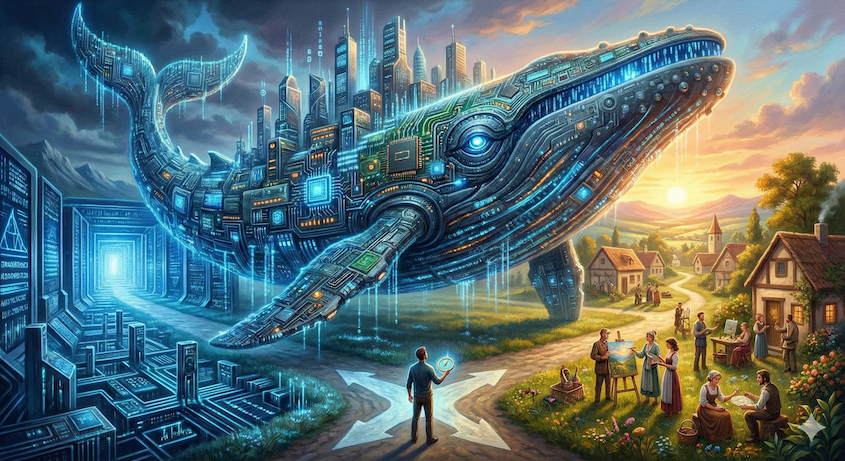
As fellow travelers in this vision, we stand at a critical fork in the road.
We could build a cold automated machine that serves only capital accumulation; or we could build an ecosystem of human-machine symbiosis and emergent wisdom. In this system, Intelligent Agents will thoroughly liberate humans from tedious tasks, allowing us to engage in work that only the soul can touch—to care, to create art, to explore the unknown, and to define love.
The twilight of management is by no means the twilight of human value, but the dawn of humans truly starting to work like “humans.”
The brilliant enterprises of the future should not merely be computational graphs possessing only “Intelligence,” but communities full of “Wisdom.” In this community, agents are responsible for extreme optimization, while humans are forever responsible for guarding the lighthouse of “Goodness” and “Beauty.”
This is not only Mr. Chen Tianqiao’s insight but also the mission that every entrepreneur stepping into this new era must shoulder.