

—— A Cybernetic Perspective on Social Fragility in the Age of AI
1. Introduction: The Cognitive Dissonance
We are witnessing a “Cambrian Explosion” of silicon-based intelligence. From the unparalleled realistic and surreal worlds rendered by Sora 2 and Veo 3.1, to the superior logical reasoning capabilities demonstrated by GPT-5 and Gemini 3, as an interdisciplinary AI researcher, I feel the tremors of the approaching singularity. However, this technological optimism is currently being challenged by a stark, paradoxical reality.
Within the same physical timeline where computational power attempts to simulate “god-like” wisdom, we observe disturbing signals of “systemic failure” at the foundation of society. Federal Reserve data indicates that in the world’s most advanced economy, 37% of adults cannot cover a $400 emergency expense. Furthermore, the recent case involving Harvard Medical School morgue manager Cedric Lodge’s trafficking of donated human remains serves as a chilling metaphor for extreme instrumental rationality: when individuals lose their value as labor resources, they are reduced to biological components for trade.
This profound cognitive dissonance compels us to re-examine our social structures through the lens of cybernetics: Why has our societal Operating System (OS), in its pursuit of “Global Efficiency Maximization,” lost its “Error Correction Mechanism” for individual survival?
2. The Cybernetic View: A System Without “Homeostasis”
In Norbert Wiener’s cybernetics, a healthy system must possess “Homeostasis”—the ability to maintain stability through Negative Feedback Loops that counteract disturbances. However, observing the current socio-economic model, we find that this mechanism has effectively failed at the grassroots level.
The $400 emergency gap is not merely a financial figure; it represents the system’s “Collapse Threshold.”
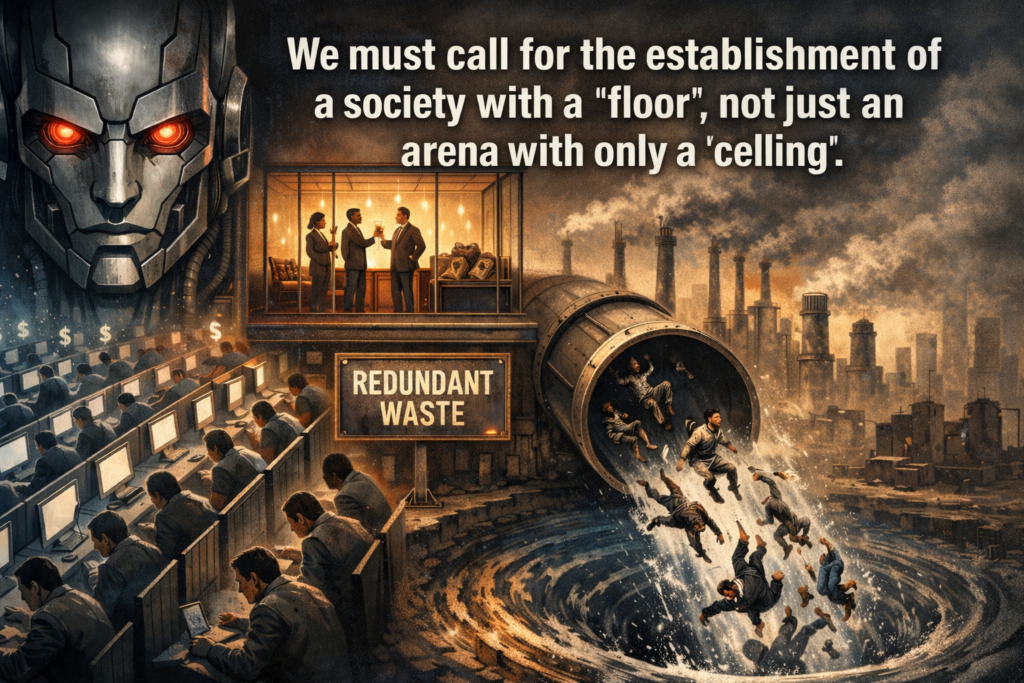
In an ideally Robust System, when an individual falls below this threshold, social safety nets should intervene as “dampers” to prevent systemic oscillation. Yet, in the prevailing model of extreme efficiency, what we witness is the malignant acceleration of Positive Feedback: a minor accident leads to default, default leads to credit bankruptcy, bankruptcy leads to loss of housing, and ultimately, a slide toward irreversible social death.
From an engineering perspective, this system design is critically dangerous. It sacrifices overall system Redundancy for the sake of localized capital efficiency. As we know from training AI models, a model that Overfits on short-term efficiency is often the most fragile when facing unforeseen perturbations.
3. The AI Paradox: Virtuous Models in a Ruthless System
This leads to a profound paradox: our AI models are becoming increasingly “civilized,” yet the economic system they inhabit remains primitively ruthless.
We must fairly acknowledge that current AI designers—from OpenAI to Google DeepMind—have made astounding progress in imbuing AI with morality and ethics. Recent studies show that models trained with RLHF often outperform humans in empathy and rational judgment. The technology itself does not lack human care; in fact, it is arguably the most rational tool we possess.
However, this is precisely where the tragedy lies: When a highly rational technology is embedded into an old economic system whose sole Objective Function is “Profit Maximization,” it does not alleviate inequality but instead becomes a “Super-Amplifier” of the system’s existing flaws.
AI holds no malice, nor do its designers. But when corporations, driven by the necessity to survive fierce market competition, must use AI to brutally compress costs, the more efficient and perfect the AI is at executing its tasks, the faster the logic chain that treats humans as “cost items” tightens. AI did not create the “Kill Line”; rather, AI’s hyper-efficiency is causing people who were once in the safety zone to hit that pre-existing red line much faster.
4. The Reality: The “Redundant Class” Is Already Here
This is no longer a prediction for tomorrow; it is the reality unfolding in 2025.
While we were debating the theories of technological unemployment, “Algorithmic Displacement” has already achieved scale deployment. This year, from Silicon Valley to Wall Street, we have witnessed massive “Silent Layoffs”: junior coding, basic data analysis, and even frontline medical diagnostics are being taken over by tireless Agents.
The automation wave that Andrew Yang once warned of has made landfall. Junior programmers, white-collar elites, and the middle class—who once believed their positions were secure—are experiencing “Class Subsidence.” They are suddenly discovering that in the face of compute costs, their years of accumulated professional skills have instantaneously depreciated.
A new social stratum—“The Redundant Class”—is forming. Unlike traditional unemployment, these individuals are not being eliminated due to laziness or lack of skill, but simply because their Marginal Output is lower than the operating cost of a GPU. If our social distribution mechanisms remain anchored solely to “labor value,” we are actively pushing thousands of well-educated individuals toward that $400 abyss.
5. Conclusion: Decoupling Survival from Labor
Facing the impending singularity, as observers of the system, we must honestly admit a brutal trend: in a future where compute costs approach zero, maintaining traditional “full employment” may become a mathematically impossible proposition.
When the marginal production cost of AI falls below the metabolic cost of humans, forcing those eliminated by the system to “reskill” or “become independent developers” is not only unrealistic but reeks of elite arrogance. The market simply does not demand that much homogenized software, nor does it need a surplus of solopreneurs squeezed by algorithms.
If “labor” is no longer the viable path for the majority to secure resources, we must fundamentally rewrite civilization’s “Objective Function”: to decouple “Survival Rights” from “Labor Value.”
We can no longer measure a person’s eligibility to exist based on their “economic output.” In this era of abundance driven by silicon intelligence, social safety nets should not be a relief station for failures, but the baseline of human civilization.
As emphasized in systems engineering regarding robustness: We must call for the establishment of a society with a “floor”, not just an arena with only a “ceiling”.
This “floor” must be solid enough to ensure that even an individual with “zero economic value” to the system is protected from falling into that $400 abyss. Even if we do not yet possess the precise roadmap to the future, we must at least acknowledge the abyss before us. Recognizing the problem is the first step in preventing system collapse.